Baby Boy Seamless Patterns: A Practical Guide for Designers and Crafters
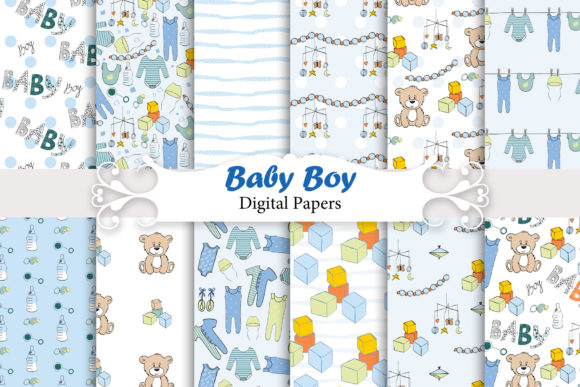
Seamless patterns designed specifically for baby boys offer more than just visual appeal—they provide functional flexibility across a wide range of creative applications. Baby Boy Seamless Patterns refer to a curated set of 12 high-resolution JPEG files, each measuring 16 by 16 inches at 300 DPI (4800×4800 pixels), optimized for tiling without visible seams. This means the pattern repeats smoothly edge-to-edge, enabling users to scale designs infinitely—whether filling a full garment panel, covering a large print surface, or building a custom digital background.
What Makes These Patterns Distinctive?
Unlike generic clipart or single-element graphics, Baby Boy Seamless Patterns are built with repeat logic in mind. Each design is carefully constructed so that the top aligns with the bottom, and the left matches the right—no manual editing or blending required. The subject matter centers on gentle, age-appropriate motifs: soft clouds, tiny stars, minimalist animals, subtle stripes, woodland creatures, and muted nautical elements—all rendered in palettes that avoid overly bright or saturated tones commonly associated with mass-market baby themes.
The technical execution matters too. At 4800×4800 pixels, these files retain crisp detail even when printed at large sizes or scaled down for delicate embroidery placements. That resolution supports professional output—whether you're printing fabric yardage for boutique baby clothes or preparing a 24×36 inch wall art piece for a nursery. And because they’re delivered as JPEGs—not layered PSDs or vector EPS files—they load quickly, open in virtually any image editor, and integrate easily into web-based design tools like Canva or Adobe Express.
How Do They Compare With Other Pattern Options?
When evaluating resources for baby-themed design work, users often encounter several categories: stock photo collections, vector pattern packs, hand-drawn illustration sets, and AI-generated pattern generators. Baby Boy Seamless Patterns sit between traditional stock assets and specialized craft kits—offering more cohesion than isolated clipart but less modularity than editable vectors.
For example, a vector-based seamless pattern pack may allow users to recolor individual elements or adjust spacing—but requires familiarity with software like Illustrator and time spent managing layers. In contrast, Baby Boy Seamless Patterns deliver ready-to-use raster files: open, place, tile, and go. That tradeoff favors speed and accessibility over deep customization.
Compared to AI-generated patterns, these files avoid unpredictability in motif consistency and licensing ambiguity. AI tools can produce endless variations, but results vary widely in stylistic cohesion, repetition accuracy, and commercial safety. Baby Boy Seamless Patterns come pre-vetted for seamless behavior and intended use—reducing trial-and-error during layout or production phases.
Key Use Cases—and Where They Shine
These patterns perform especially well in contexts where repetition, scalability, and thematic consistency are priorities:
- Scrapbooking and paper crafts: Print onto cardstock or specialty paper for custom envelopes, gift tags, or layered album pages. Because the patterns tile cleanly, you can create continuous borders or full-page backgrounds without alignment headaches.
- Apparel and textile design: Apply to onesies, swaddles, bibs, or crib sheets using heat-transfer vinyl or direct-to-garment printing. The 300 DPI resolution ensures clarity even on fine-knit cotton fabrics.
- Digital projects: Use as website backgrounds, social media banners, or email newsletter headers—especially for baby boutiques, lactation consultants, or pediatric services seeking warm, cohesive branding.
- Print-on-demand products: Integrate into platforms like Printful or Redbubble without resizing concerns. The square dimensions simplify upload workflows, and the seamless nature avoids edge artifacts on mugs, tote bags, or phone cases.
They’re less suited for applications requiring transparency (e.g., overlays on photos), intricate color replacement, or animation—since JPEGs don’t support alpha channels or frame sequencing. If your workflow depends heavily on layering or dynamic color shifts, you’d likely need supplemental tools or formats.
Realistic Tradeoffs to Consider
One practical limitation is format dependency. Because these are raster JPEGs—not vectors or SVGs—they don’t scale infinitely without potential pixelation if enlarged beyond their native dimensions. While 4800×4800 px covers most common needs (including billboard-sized prints at viewing distance), ultra-high-magnification uses—like macro textile embroidery previews—may benefit from vector alternatives.
Another consideration is stylistic scope. The kit includes 12 coordinated designs, not hundreds. That’s intentional: it encourages thoughtful selection rather than overwhelming choice. But if you regularly switch between bold, modern, vintage, and whimsical aesthetics across client projects, you may find yourself supplementing with additional themed packs—or relying on this set as a consistent “base” style for a particular brand identity.
Licensing is straightforward: the files are cleared for both personal and commercial use, including resale of physical products (e.g., printed onesies or greeting cards). However, they cannot be resold or redistributed as standalone digital assets—so they’re not appropriate for designers building their own pattern marketplaces or template libraries.
When Is This the Right Choice?
Baby Boy Seamless Patterns tend to be most valuable for users who prioritize reliability over experimentation—those who need predictable, print-ready assets without investing time in pattern creation or troubleshooting tiling glitches. It’s a strong fit for:
- Small business owners launching a baby-focused product line and needing cohesive, on-brand visuals fast;
- Crafters who prefer hands-on making over digital manipulation and want to minimize prep time;
- Freelance designers working under tight deadlines for clients in parenting, healthcare, or education sectors;
- Teachers or community organizers creating printable resources—like growth charts or milestone cards—with unified visual language.
If your work involves frequent rebranding, highly technical textile engineering, or collaborative design systems requiring shared asset libraries, you may benefit more from scalable vector formats or subscription-based pattern services with broader stylistic ranges.
Making an Informed Decision
Before choosing Baby Boy Seamless Patterns—or any similar resource—consider three practical questions:
- What’s your primary output medium? If most of your work ends up printed on fabric or paper, high-resolution JPEGs are often more practical than smaller web-optimized files or untested AI outputs.
- How much time do you have for setup versus creation? Seamless patterns that work immediately reduce testing cycles—valuable when balancing multiple projects or tight launch windows.
- Do you need variation—or consistency? A focused kit like this supports strong visual continuity across touchpoints; larger libraries offer flexibility but may dilute brand voice without careful curation.
No single solution fits every need. Baby Boy Seamless Patterns excel where clarity, cohesion, and compatibility matter more than infinite customization. They reflect a deliberate balance: professional-grade specs paired with accessible delivery. For many creators, that balance translates directly into fewer revisions, smoother production, and more time spent designing—not debugging.
If you're unsure whether this set aligns with your current project requirements, reaching out with specific questions is encouraged. Real-world context helps clarify fit—whether you're planning a seasonal collection, updating a website, or prototyping a new product line. Thank you for considering Baby Boy Seamless Patterns as part of your creative toolkit.