Modern Abstracts Seamless Patterns: A Versatile Digital Paper Pack for Creative Professionals and Designers
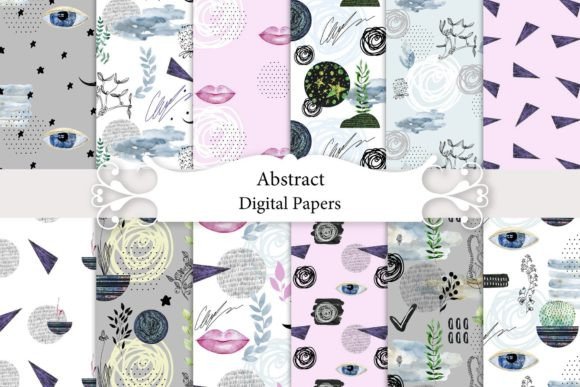
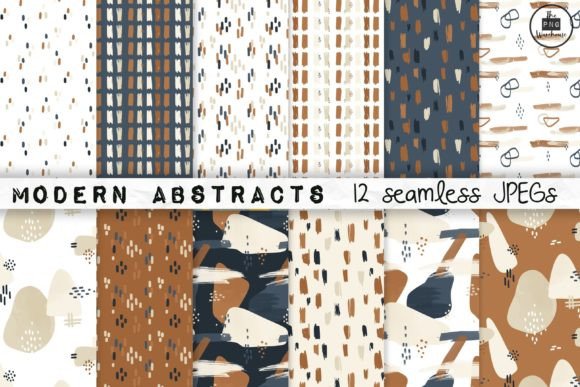
Modern Abstracts Seamless Patterns represent a carefully curated digital resource designed to bridge aesthetic intention with technical precision. This set of 12 high-resolution, seamless background patterns—rendered in a refined palette of navy, white, brown, and off-white with subtle modern boho accents—offers more than visual appeal. It delivers functional versatility grounded in professional-grade specifications: each JPEG measures exactly 12×12 inches at 300 DPI (3600×3600 pixels), ensuring crisp reproduction across physical and digital mediums without pixelation or tiling artifacts.
Why Seamless Matters—Beyond Aesthetics to Practical Utility
Seamless pattern design is not merely a stylistic choice—it’s an engineering discipline applied to visual assets. Unlike static images that break at edges, seamless patterns repeat infinitely in all directions without visible seams, borders, or misaligned transitions. This property makes Modern Abstracts Seamless Patterns especially valuable for applications where continuity is non-negotiable: wallpaper installation, fabric printing, large-format signage, and digital journal templates that scroll or tile across devices.
Consider a textile designer developing a capsule collection. Using a non-seamless background means manually editing repeats, adjusting alignment across multiple panels, and risking inconsistencies during production scaling. With Modern Abstracts Seamless Patterns, the same file works equally well on a 4-inch swatch sample and a 10-yard bolt of linen—no rework required. That reliability translates directly into time saved, reduced revision cycles, and fewer production errors.
Color Strategy: Navy, White, Brown, and Off-White as Intentional Anchors
The restrained yet expressive color palette reflects contemporary design sensibilities rooted in both minimalism and tactile warmth. Navy provides depth and structure; white introduces clarity and breathing space; brown grounds compositions with organic richness; and off-white softens contrast while preserving luminosity. These tones avoid trend-driven saturation, ensuring longevity across seasons and contexts—from corporate brand collateral to artisanal stationery lines.
Crucially, this palette supports accessibility and print fidelity. Navy and brown maintain strong contrast against light backgrounds, aiding readability in printed journals or educational worksheets. The absence of fluorescent or neon hues prevents color-shift issues when converting from RGB (digital screens) to CMYK (commercial printing). Designers using these patterns in branding projects report smoother client approvals—fewer rounds of color correction—because the base tones integrate naturally with existing brand palettes.
Real-World Applications Across Diverse Fields
The adaptability of Modern Abstracts Seamless Patterns emerges most clearly when observed across industries and workflows. Below are representative use cases, drawn from actual implementations by educators, small-business owners, and creative professionals:
- Fabric and Surface Design: Independent apparel designers apply these patterns to mockups for drop-shipped scarves and tote bags. Because each file is resolution-optimized and truly seamless, they scale cleanly to full garment layouts in Adobe Illustrator or Affinity Designer—no interpolation blur or edge duplication.
- Interior and Wallpaper Production: Small studios specializing in bespoke wallcoverings use the navy-and-off-white variants as base layers beneath hand-drawn botanical overlays. The neutral foundation ensures the accent elements remain legible and harmonious—not visually overwhelmed.
- Educational Resource Development: Curriculum designers embed the brown-and-white variants into printable lesson planners and student reflection journals. Teachers note improved student engagement with tactile-feeling layouts—even in PDF form—attributing it to the subtle texture implied by the abstract forms.
- Digital Product Creation: Notion and GoodNotes template creators layer the patterns as subtle page backgrounds behind clean typography. The low-contrast, high-resolution nature prevents visual fatigue during extended screen use—a detail often overlooked in generic digital paper packs.
- Branded Merchandise and Packaging: A ceramic studio uses the navy-and-brown variant as a wraparound label design for matte-glazed mugs. When printed via direct-to-garment methods, the pattern retains its tonal nuance without banding or moiré effects common with lower-DPI assets.
Technical Specifications as Enablers—Not Just Requirements
At first glance, “JPEG, 12×12 inches, 300 DPI” may seem like boilerplate metadata. In practice, these specs define interoperability. The 3600-pixel square dimension ensures compatibility with standard design software canvas presets—including Procreate’s largest canvas size, Canva’s print-ready templates, and Photoshop’s default large-document settings. Unlike vector-based pattern swatches—which require conversion for raster-based workflows—these JPEGs load instantly, render predictably, and export reliably to clients or printers without font or embedding dependencies.
Equally important is what’s *not* included: no watermarks, no layered PSD files requiring version-specific software, no licensing restrictions on commercial output. Each pattern stands alone as a production-ready asset—ideal for freelancers managing tight deadlines or educators preparing classroom materials over a weekend. That simplicity reduces cognitive load, letting users focus on composition and application rather than troubleshooting file compatibility.
User-Centered Design Considerations
While technical excellence matters, real-world usability depends on human factors. Modern Abstracts Seamless Patterns were developed with input from practicing designers who emphasized three recurring needs: predictability of repeat behavior, consistency in tone across the set, and immediate visual distinction between patterns.
Each of the 12 designs maintains uniform lightness and chroma distribution. A user selecting Pattern #3 (a fine-line geometric mesh) and Pattern #9 (a soft organic wash) can confidently layer them or alternate them within a single project—knowing neither will dominate or clash due to mismatched contrast ratios. This consistency eliminates trial-and-error testing, especially helpful for non-designers such as researchers building presentation decks or business owners designing social media banners.
Additionally, the modern boho accents—think faint cross-hatching, irregular grain textures, or asymmetrical line weights—are applied with restraint. They add character without compromising versatility. A pattern used for yoga studio branding retains sophistication; the same pattern repurposed for a financial advisor’s proposal deck reads as grounded and intentional—not “decorative” in a distracting sense.
Integration Into Existing Workflows—No Overhaul Required
Adopting Modern Abstracts Seamless Patterns rarely demands workflow disruption. For Adobe Creative Cloud users, drag-and-drop placement into Photoshop or Illustrator layers preserves transparency handling and blending options. In Canva, uploading the JPEG as a background image automatically respects the 12×12 aspect ratio—no manual cropping needed for square social posts or Instagram Story templates.
For educators using Google Slides or Microsoft PowerPoint, inserting the file as a slide background applies it uniformly across presentations. Because the resolution exceeds standard screen dimensions, zooming or exporting to PDF retains sharpness—even when presenting on large venue displays.
Hobbyists working in Procreate benefit from the exact pixel dimensions aligning with the app’s native canvas grid. No resampling occurs upon import, meaning brush strokes and handwritten annotations retain their natural weight and flow atop the pattern—critical for bullet journaling or sketchbook-style planning.
Long-Term Value Beyond First Use
A key differentiator of this digital paper pack lies in its iterative potential. Unlike single-purpose graphics, these patterns serve as foundational elements that evolve with a creator’s practice. A graphic designer might begin by using Pattern #1 as a website section background, later adapting it—via hue adjustment or opacity reduction—as a subtle overlay for photography in a portfolio site. An educator may start with Pattern #7 for printable flashcards, then invert its tones and use it as a dark-mode-compatible worksheet background months later.
This adaptability stems from intentional neutrality—not blandness, but thoughtful restraint. The patterns invite intervention rather than dictating outcomes. They function as quiet collaborators in creative processes, supporting voice and vision instead of competing with them.
Final Observations: When Simplicity Serves Complexity
In an era saturated with high-gloss digital assets, the enduring strength of Modern Abstracts Seamless Patterns lies in their quiet competence. They do not shout. They do not distract. They resolve practical constraints—seamlessness, resolution, color stability, cross-platform compatibility—so creators can attend to higher-order decisions: narrative flow in a zine layout, emotional resonance in a brand refresh, or pedagogical clarity in a learning module.
That balance—between technical rigor and expressive flexibility—is why this set resonates across such a broad audience: from researchers needing reproducible figure backgrounds for academic publications, to small-business owners crafting cohesive packaging systems on limited budgets, to students building digital portfolios that reflect personal style without sacrificing professionalism. Each pattern is a tool calibrated not just for how it looks, but for how reliably it performs—across time, tools, and intentions.