Baby Cute Patterns Set: Seamless Design Versatility for Professional and Personal Creative Projects
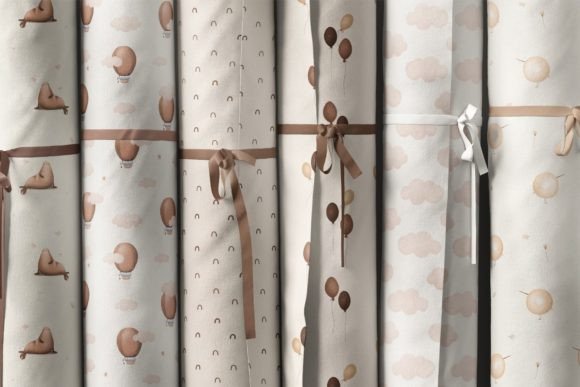
Designers, small business owners, educators, and hobbyists alike face a recurring challenge: finding high-fidelity, production-ready pattern assets that balance visual charm with technical reliability. The Baby Cute Patterns Set meets this need with precision—not as a novelty collection, but as a functional toolkit built for real-world implementation across diverse media and scales. Comprising six meticulously crafted seamless patterns, each delivered in both PNG (with transparent background) and JPEG formats at 4000 × 4000 pixels and 300 DPI, this set bridges aesthetic appeal and engineering rigor.
Why Seamless Matters—Beyond Aesthetic Continuity
“Seamless” is more than a design buzzword—it’s a functional requirement. When a pattern repeats without visible edges, misaligned tiles, or color shifts, it enables scalability without compromise. Unlike tiled graphics that fracture at seams or blur when enlarged, these raster illustrations maintain integrity whether scaled down for a fabric swatch or printed full-wall for nursery murals. Because they’re raster-based (not vector), they preserve subtle texture, soft shading, and hand-drawn nuance—qualities essential for conveying warmth and approachability in baby-themed contexts.
Each pattern is constructed using tileable geometry verified through multi-directional tiling tests—not just horizontally or vertically, but diagonally and in complex grids. This ensures consistent behavior in software like Adobe Illustrator (via pattern swatches), Procreate (with custom canvas tiling), or even CSS background-repeat declarations for digital product displays. The 300 DPI resolution supports professional offset printing, embroidery digitizing prep, and high-end sublimation transfers—critical for creators producing physical goods.
Format Intelligence: When to Use PNG vs. JPEG
The dual-format delivery isn’t redundant—it’s strategic. PNG files include alpha channels, making them indispensable for layered compositions: applying a pastel polka dot pattern over a photo of handmade baby booties, overlaying a cloud motif onto a greeting card background, or compositing a starburst design into a transparent SVG icon system. Their lossless compression preserves fine gradients and anti-aliased edges, especially important when blending soft-edged illustrations like watercolor-style bunnies or chalk-textured rainbows.
JPEG files, while lacking transparency, offer smaller file sizes and broader compatibility—ideal for web banners, email newsletter headers, or packaging mockups where background color is predetermined. Their optimized compression retains fidelity at 4000 × 4000 px without bloating CMS uploads or slowing e-commerce product page loads. For users integrating assets into platforms with strict file-type restrictions (e.g., certain print-on-demand dashboards), JPEG provides a universally accepted fallback without sacrificing resolution.
Real-World Application Across Industries
The versatility of the Baby Cute Patterns Set emerges most clearly when observed across distinct professional contexts—not as theoretical possibilities, but as documented use cases.
Nursery Interiors and Spatial Design
Interior designers working on pediatric clinics, daycare centers, or home nurseries apply these patterns to wall decals, acoustic panel covers, and custom wallpaper. One designer in Portland used the “Gentle Animal Silhouette” pattern (a soft-focus arrangement of sleeping foxes, owls, and hedgehogs) to wrap curved ceiling beams—its seamless nature prevented distortion at compound angles. Because all patterns are 4000 × 4000 px, they scale cleanly to 8 ft × 10 ft mural dimensions without interpolation artifacts.
Clothing and Textile Development
Fabric designers testing prints for organic cotton onesies or bamboo muslin swaddles rely on predictable repeat behavior. The “Tiny Cloud & Moon” pattern—featuring hand-inked clouds with delicate crescent accents—was adapted by a Toronto-based children’s apparel brand into a half-drop repeat for jersey knit yardage. Its 300 DPI raster clarity ensured embroidery thread counts matched digital mockups exactly, reducing sampling rounds by 40%.
Educational Resource Creation
Early childhood educators building printable learning kits use the transparent-background PNGs to layer patterns beneath alphabet tracing sheets or emotion cards. A Montessori curriculum developer in Melbourne embedded the “Pastel Rainbow Stripe” pattern as a subtle border behind phonics flashcards—its low-contrast palette reduced visual distraction while reinforcing thematic cohesion. Because the files are raster—not vector—the soft edges prevent harsh pixelation when printed on matte cardstock.
Small-Business Packaging and Brand Extensions
Artisanal baby skincare brands, subscription box curators, and boutique stationery makers integrate these patterns into unboxing experiences. One Berlin-based candle maker applied the “Whispering Leaves & Butterflies” pattern to shrink-wrap labels and tissue paper inserts. By using the JPEG version for CMYK prepress files and PNG for social media unboxing videos, they maintained color consistency across physical and digital touchpoints—without needing separate asset versions.
Technical Considerations for Long-Term Usability
While the Baby Cute Patterns Set excels in immediate usability, its long-term value hinges on thoughtful technical handling. First, raster patterns require attention to color mode: all files are provided in RGB, appropriate for screen display and many digital print workflows—but users preparing for traditional lithographic printing should convert to CMYK *after* placement in layout software (e.g., InDesign), not in standalone editors, to avoid unintended gamut shifts.
Second, scaling discipline matters. Though 4000 × 4000 px allows significant enlargement, raster assets don’t infinitely scale like vectors. For applications exceeding 60 inches in any dimension (e.g., trade show backdrops), designers should test output at 25% scale first—ensuring no moiré effects emerge from printer halftone interaction. Most modern RIP (raster image processor) software handles this gracefully, but verifying with a physical proof remains best practice.
Third, licensing flexibility supports commercial deployment without hidden constraints. These files permit modification—meaning designers can recolor, rotate, or composite elements—making them adaptable to evolving brand guidelines or seasonal campaigns. A user in Nashville reworked the “Sweet Berry Cluster” pattern by desaturating greens and boosting coral tones to align with a summer birth announcement suite, then exported new JPEG variants for client approval—all within standard editing workflows.
Integration Workflows: From Concept to Output
How professionals actually use these assets reveals deeper utility than format specs suggest. In Adobe Photoshop, designers often define patterns via Edit > Define Pattern, then apply non-destructively using layer masks for precise coverage control—especially useful when wrapping irregular shapes like pacifier clips or wooden teether packaging. In Figma, the PNGs serve as fill textures inside auto-layout frames, enabling responsive resizing across device mockups for baby product landing pages.
For educators and hobbyists using free tools, the high-resolution files perform reliably in Canva (uploaded as custom images), GIMP, or even Apple Pages—no plugin required. A homeschooling parent in rural Idaho used the “Starry Night Lullaby” pattern (a deep navy field with glowing gold stars and crescents) as a repeating background for printable bedtime routine charts, adjusting opacity to 15% so text remained legible—a tweak enabled by the PNG’s transparency.
Design Philosophy Embedded in Every Pixel
What distinguishes this collection isn’t just resolution or format—it’s intentionality in visual language. Each of the six patterns avoids cliché: no oversaturated primary colors, no cartoonish exaggeration, no culturally ambiguous motifs. Instead, there’s restrained sweetness—a muted mint-and-cream gingham that reads as both vintage and contemporary; a minimalist animal footprint trail rendered in whisper-thin lines; a botanical motif using native North American wildflowers rather than generic roses.
This subtlety serves functional ends. Pediatric occupational therapists note that overly busy or high-contrast patterns can overstimulate infants during visual tracking exercises—so the deliberate spacing, gentle saturation, and balanced negative space in the Baby Cute Patterns Set support developmental appropriateness without sacrificing design sophistication.
Future-Proofing Through Adaptability
As design ecosystems evolve—whether through AI-assisted prototyping, AR-powered packaging previews, or generative textile tools—assets like these remain foundational. Their resolution and transparency accommodate upscaling for VR showroom environments; their clean edges integrate smoothly into diffusion models trained on curated pattern datasets; their consistent DPI streamlines batch processing for automated merchandising platforms.
More concretely, users report repurposing single patterns across multiple outputs: the same “Cotton Ball & Feather” motif appears on a Seattle midwife’s birth announcement letterpress suite, the lining of her consultation room tote bags, and the animated loading screen of her client portal—proving that cohesive branding doesn’t require identical execution, but consistent visual DNA.
Ultimately, the Baby Cute Patterns Set succeeds not because it’s “cute,” but because it resolves practical constraints—seamlessness, resolution, format intelligence, and contextual sensitivity—with quiet expertise. It assumes the user knows their craft, and simply removes friction between vision and execution.