Seamless Barbed Wire Patterns
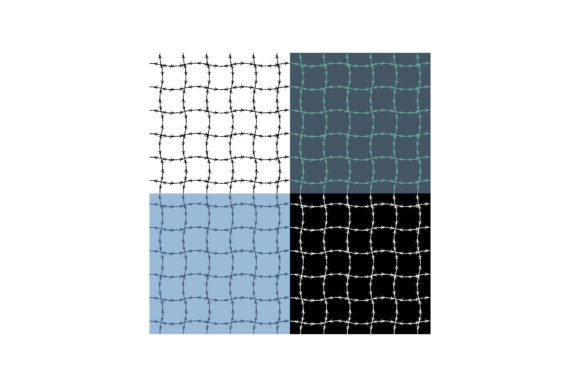
Seamless barbed wire patterns are vector-based, tileable designs that repeat infinitely without visible seams—ideal for fabric printing, surface decoration, digital overlays, or print-on-demand projects. Unlike raster images, these vector patterns scale cleanly at any size and adapt smoothly to curves, folds, or complex layouts. They’re not just “prison bar” motifs; they carry texture, tension, and symbolic weight—evoking security, resistance, boundary, or even rebellion—while remaining technically precise and production-ready.
Why This Matters—Depending on Who You Are
What feels like a simple design element shifts meaning—and utility—across roles. A fashion designer sees structure and edge; an educator uses it to spark discussion about symbolism in visual language; a small-batch textile printer needs reliable color separation and bleed tolerance. No single use case defines the pattern. Its value emerges from how well it serves your workflow, intent, and constraints.
For Fabric Designers & Print-on-Demand Sellers
If you’re creating custom apparel, home textiles, or limited-run tote bags, seamless barbed wire patterns offer instant visual impact with zero tiling glitches. Because they’re vector-based, you can adjust stroke weight, spacing, or color mode without pixelation—critical when scaling from a pocket detail to a full curtain panel. One user resized a pattern to 300% for a denim jacket back panel and kept crisp edges; another converted strokes to outlines before sending files to a DTG printer, avoiding unexpected thinning during RIP processing.
- Priority: Output reliability, CMYK/RGB flexibility, and compatibility with common textile software (Adobe Illustrator, Affinity Designer, Spoonflower’s uploader)
- Watch for: Overly dense patterns that may clog fine-weave fabrics—or conversely, too-sparse repeats that lose definition on coarse canvas.
For Graphic Designers & Brand Creators
Barbed wire isn’t just literal—it’s a versatile ornament. Used subtly as a border, watermark, or background layer, it adds grit without dominating. A branding agency incorporated a low-opacity version into a packaging line for an urban wellness brand, signaling resilience without aggression. Another designer layered it under typography for a protest art zine, adjusting opacity and blending mode to control emotional tone.
Vector format means you can recolor in seconds, invert for dark-mode assets, or isolate segments for custom icons. No need to redraw: just ungroup, delete unwanted paths, or apply global swatches.
For Educators & Workshop Leaders
In design or media literacy classes, seamless barbed wire patterns serve as concrete examples of repetition, rhythm, and symbolic coding. Students can dissect how spacing affects perception (tight spacing reads as containment; wide spacing suggests surveillance), or explore how vector scalability supports accessibility—e.g., enlarging patterns for tactile learning tools without losing fidelity.
One high school visual arts teacher used a simplified version as a scaffolded Illustrator exercise: students started by rotating and mirroring a single segment, then built their own seamless tile—deepening understanding of pattern logic beyond copy-paste.
For Hobbyists & DIY Makers
You don’t need professional software to benefit. Many vector patterns open cleanly in free tools like Inkscape or even newer web apps like Vectr. Resize, recolor, or export as PNG for heat-transfer vinyl cutting or Cricut projects. A quilter printed a scaled-down version onto fusible webbing, then ironed sections onto denim patches—no sewing machine needed for the motif itself.
Beginners often prioritize clarity over complexity: look for sets that include labeled layers (e.g., “outline only,” “filled,” “halftone variant”) and basic documentation—not tutorials, but clear naming and grouping so you know what each file does at a glance.
What to Evaluate—Beyond Aesthetics
Before downloading or purchasing, ask yourself:
- Is the tile size practical? Too small (e.g., 50×50 px) risks repetition fatigue on large surfaces; too large (e.g., 2000×2000 px) bloats file size and slows editing. A balanced range—like 300×300 px to 800×800 px—is ideal for most fabric and screen uses.
- Are anchor points clean? Poorly constructed vectors accumulate stray nodes or overlapping paths—causing rendering hiccups in laser cutters or embroidery software. Zoom in: if corners look jagged or grouped objects behave unpredictably when selected, the build may need cleanup.
- Does it support your output path? If you’re printing via Spoonflower, check whether the set includes RGB and CMYK versions. For sublimation, verify whether fills use solid colors (not gradients) and strokes are outlined—not just stroked.
Flexibility vs. Fidelity
Some users want raw modularity: separate barbed wire strands, isolated bar shapes, and modular corner elements—so they can build custom configurations. Others need plug-and-play tiles that drop into place with no editing. Neither is “better.” It depends on whether you’re iterating rapidly (favoring ready-to-use) or building a signature visual system (favoring component-based).
A freelance surface pattern designer used the modular components to create a hybrid motif—interweaving barbed wire with climbing ivy—by aligning anchor points and applying consistent Pathfinder operations. Meanwhile, a café owner choosing tablecloth prints selected the pre-tiled version, uploaded it directly to her vendor, and approved the proof in under five minutes.
When This Pattern Fits—And When It Might Not
This set shines in contexts where controlled intensity matters: streetwear graphics, editorial illustrations, security-themed event branding, or conceptual textile art. It works less well for applications requiring softness, warmth, or organic flow—think baby blankets, wellness brochures, or hospitality interiors—unless intentionally subverted (e.g., barbed wire rendered in pastel yarn textures).
Also consider cultural resonance. In some communities, barbed wire carries heavy historical or political associations. If your project reaches diverse audiences, test usage with sensitivity readers or contextualize it deliberately—through pairing, captioning, or contrast—rather than assuming neutrality.
Ultimately, Set of Seamless Patterns with Barbed Wir isn’t about shock value. It’s about precision, intention, and adaptability—whether you’re screen-printing ten hoodies or developing a semester-long unit on visual metaphor. The right pattern doesn’t shout; it supports, clarifies, and scales with you.