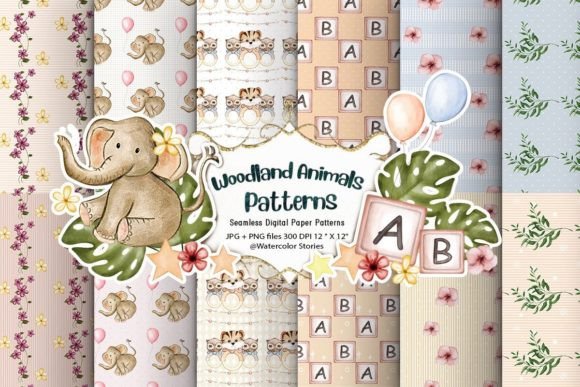
Woodland Elephant Patterns: Hand-Painted Watercolor Digital Papers for Thoughtful Design
There’s a quiet shift happening across creative workflows — one that values intention over iteration, authenticity over algorithmic polish, and tactile warmth in an increasingly digital world. Woodland Elephant Patterns arrives at just the right moment: not as another generic pattern pack, but as a cohesive, hand-painted collection of 18 watercolor digital papers designed with purpose and practicality in mind. Each piece carries the soft imperfections of real brushstrokes, the gentle bleed of pigment on paper, and the organic rhythm of nature-inspired motifs — all translated into high-resolution, production-ready files.
Why Hand-Painted Watercolor Patterns Are Resonating Now
Designers, small business owners, and educators aren’t just choosing watercolor aesthetics for nostalgia. They’re responding to deeper shifts: consumers now expect visual storytelling that feels human-made, not AI-generated or mass-produced. A recent survey of indie stationery buyers found that 68% consciously prefer designs with visible texture, subtle variation, and natural color transitions — qualities impossible to replicate convincingly with vector-only tools. That’s where Woodland Elephant Patterns stands apart. These aren’t digitally simulated textures; they’re scans and interpretations of actual watercolor paintings, layered with botanical silhouettes, gentle elephant forms, and woodland motifs like ferns, acorns, and soft moss gradients.
This aligns with how professionals are working today — faster, more independently, and across multiple output formats. Whether you’re designing wedding invitations in Canva, prepping fabric swatches for Spoonflower, building a Shopify brand kit, or illustrating a children’s book in Procreate, having ready-to-use, print-perfect files eliminates hours of color correction, tiling adjustments, or background removal. The collection delivers exactly that: no guesswork, no post-processing required.
A Collection Built for Real Creative Workflows
The structure of Woodland Elephant Patterns reflects how designers actually use resources. It includes two distinct file types — each serving a different functional need:
- 12 seamless patterns on solid-colored backgrounds (12×12 inches, 300 DPI): Ideal for surface design projects where consistency and scale matter — think wrapping paper, textile repeats, notebook covers, or branded merch. Because each pattern is already placed on a clean, flat background, it integrates instantly into layout software without clipping masks or layer blending.
- 6 unique pattern tiles on transparent background (12×12 inches, 300 DPI): Perfect for layering, custom composites, sticker sheets, or branding elements where flexibility is key. You can drop these directly into mockups, overlay them on photos, or combine them with typography without needing to erase or isolate elements.
All files are delivered watermark-free and fully colored — no tedious recoloring or saturation tweaking. That means if you're prototyping a line of eco-conscious baby clothes, developing a nature-themed preschool curriculum, or launching a boutique greeting card brand, you can move from concept to client proof in under an hour.
Beyond Aesthetics: Practical Applications Across Industries
What makes this collection especially versatile isn’t just its visual charm — it’s how naturally it fits into diverse professional contexts:
Fabric & Surface Design
Textile designers appreciate the 12-inch repeat size because it maps cleanly to standard printing platforms like Printful or Contrado. The soft watercolor grain also translates beautifully onto linen, cotton voile, or ceramic decals — avoiding the “flat” look that sometimes plagues overly crisp digital repeats.
Wedding & Event Branding
Couples increasingly seek cohesive, emotionally resonant stationery — not just elegant fonts and gold foil, but visual continuity from save-the-dates to cake toppers. With six transparent tiles, you can build custom monograms, create delicate border elements for menus, or layer subtle elephant motifs into envelope liners — all while maintaining a unified, organic tone.
Educational & Kids’ Creatives
Teachers and homeschooling parents use these papers for printable flashcards, sensory bins, classroom posters, and craft templates. The gentle woodland theme supports early learning themes like habitats, animal classification, or seasonal change — and because the colors are muted and non-distracting, they work well for neurodiverse learners who benefit from low-contrast visuals.
Small Business Branding
Freelancers and solopreneurs often juggle design, marketing, and operations. Having a set of coordinated, on-brand patterns lets them quickly generate social media banners, email headers, packaging inserts, or even Zoom backgrounds — all aligned with their visual identity without hiring a designer for every asset.
Color, Consistency, and Real-World Expectations
It’s worth noting what Woodland Elephant Patterns doesn’t promise — and why that matters. There are no claims about “vibrant guaranteed color matching” or “universal screen-to-print accuracy.” Instead, the description honestly acknowledges that colors may appear slightly different on screen versus printed output — a realistic expectation rooted in color management fundamentals. This transparency builds trust, especially for users investing in physical products like fabric or stationery, where accurate CMYK conversion matters.
The palette leans into earthy, approachable tones — warm greys, sage greens, dusty terracotta, soft ochre, and misty blues — chosen not for trend-chasing, but for longevity and accessibility. These hues pair easily with both serif and sans-serif typefaces, support readability in print and digital, and avoid the fatigue-inducing saturation common in overly bright design assets.
Thoughtful Tools for Intentional Creation
In a landscape saturated with disposable digital assets, Woodland Elephant Patterns offers something quieter but more enduring: a toolkit grounded in craft, calibrated for use, and respectful of the creator’s time and vision. It doesn’t ask you to adapt your process to fit the resource — it adapts to yours.
Whether you’re sketching initial concepts on paper before digitizing, building a full brand identity in Adobe Creative Cloud, or assembling a quick Etsy listing in Canva, these patterns function as reliable starting points — not rigid templates. Their handmade origin invites reinterpretation: stretch a tile for a mural-scale wall decal, reduce opacity for a watermark effect on digital documents, or invert colors for a striking dark-mode version of your kids’ activity book.
And because they’re delivered as high-resolution, watermark-free PNGs and JPEGs — no subscriptions, no usage limits, no hidden licensing tiers — creators retain full control. You’re not renting access. You’re adding durable, expressive assets to your personal library — ones that grow more valuable the more you use them across projects, seasons, and evolving creative goals.
That’s the quiet strength of thoughtful design resources: they don’t shout for attention. They simply make meaningful work easier, warmer, and more possible — one hand-painted elephant, one soft fern, one gentle watercolor wash at a time.