Zebra and Guitar Seamless Patterns
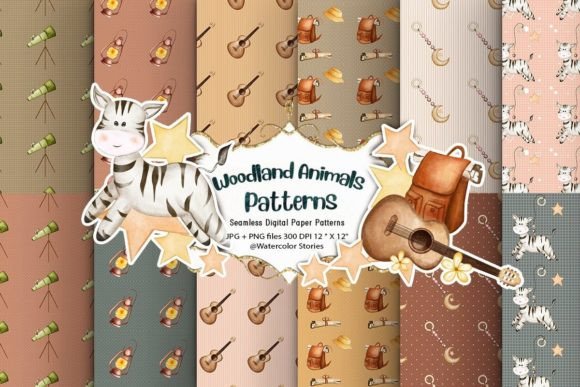
If you’ve ever stared at a blank design canvas—whether it’s a wedding invitation, a fabric swatch for your small-batch clothing line, or the background for your kids’ handmade birthday cards—and thought, “I need something fresh, playful, and instantly usable,” then Zebra and Guitar Seamless Patterns might be exactly what bridges that gap. This isn’t just another generic pattern pack. It’s a curated set of 18 hand-painted watercolor digital papers—each one built with real creative work in mind.
What You’re Actually Getting (and Why It Matters)
There are two core components: 12 seamless patterns on solid-colored backgrounds (12×12 inches, 300 DPI), and 6 unique pattern tiles with transparent backgrounds (also 12×12 inches, 300 DPI). All files are watermark-free, ready to drop into your projects without extra cleanup. They’re colored, high-resolution, and designed for both screen and print—so whether you’re prepping for a local print shop or exporting straight to Canva or Adobe Illustrator, you won’t hit a resolution wall.
The zebra motifs bring rhythm and graphic contrast—think bold stripes softened by watercolor texture. The guitar elements add warmth, movement, and a subtle musical personality—not literal instruments, but stylized, flowing shapes that echo strings, curves, and resonance. Together, they create visual tension and harmony, making this collection unusually versatile across themes: modern rustic, indie craft, playful education, even minimalist branding with character.
Where These Patterns Show Up in Real Life
Let’s talk about where people actually use them—not just “scrapbooking” as a category, but what that looks like on a Tuesday afternoon:
- A freelance stationery designer building a custom wedding suite for a couple who met at a music festival—uses the transparent guitar tile to layer over ivory linen-textured paper, then adds foil accents. The zebra pattern becomes the envelope liner, giving tactile surprise when opened.
- A homeschooling parent printing themed learning mats for their 7-year-old: guitar-shaped counting cards with watercolor borders, zebra-striped flashcards for phonics practice. Because the files are print-ready and color-balanced, there’s no guesswork before loading the printer.
- A small-batch apparel brand testing a limited run of tote bags—drops the zebra pattern onto a navy organic cotton base in Illustrator, scales it perfectly using the seamless tile, and sends straight to their DTG printer. No repeat glitches. No awkward edges.
- An educator creating classroom posters pulls the transparent guitar tile into Google Slides, places it behind student name tags, and prints full-page displays for the reading corner. The soft watercolor edge keeps it warm—not sterile—without overwhelming young readers.
- A blogger launching a new planner line uses the solid-background zebra patterns as divider pages and the transparent guitar motif as subtle headers on weekly layout templates. Since all files are 300 DPI, her PDF downloads retain crispness—even when customers zoom in on tablets.
Who Benefits—and How Their Needs Shape Use
It’s not just *what* the patterns are—it’s how different users interact with them based on their tools, time, and goals.
Hobbyists and makers appreciate that nothing needs recoloring or masking. If you're cutting vinyl stickers for your Etsy shop or printing labels for homemade jam jars, you open the file, place it, and go. There’s no learning curve—just immediate utility.
Small business owners value consistency and scalability. Because each pattern is truly seamless and high-res, you can scale from a 2-inch sticker to a 48-inch wall mural without pixelation or visible repeats. That flexibility means one purchase supports multiple product lines—fabric, packaging, social media banners—without buying separate assets.
Educators and content creators often juggle tight budgets and tighter deadlines. These patterns let them elevate handouts, slide decks, or printable worksheets without licensing headaches or attribution requirements. And because they’re watercolor-based—not clipart—they feel personal, not generic.
Things to Keep in Mind Before You Download
These patterns shine brightest when matched to your workflow—but a few practical notes help avoid hiccups:
- Color accuracy varies. What you see on your monitor may differ slightly from printed output—especially on uncalibrated screens or matte vs. glossy paper stocks. If color matching is mission-critical (e.g., brand guidelines), order a test print first.
- Transparent tiles require basic layering skills. You’ll need software that supports PNG transparency (Canva Pro, Photoshop, Affinity Designer, even newer versions of PowerPoint). Free tools like Photopea work too—but basic Canva free tier doesn’t preserve transparency in uploads.
- “Seamless” means repeatable—not automatically sized. While the tiles are built to tile infinitely, you’ll still adjust scale and positioning in your design app to suit your project (e.g., a subtle background vs. a bold focal repeat).
- No commercial license restrictions—but no reselling of the files themselves. You’re free to use them in client work, products you sell, or digital downloads you offer. You just can’t repackage and resell the pattern files as your own asset pack.
Why This Collection Fits Into Everyday Creative Routines
Most digital paper packs fall into one of two traps: overly literal (e.g., “music notes on sheet music”) or so abstract they lack personality. Zebra and Guitar Seamless Patterns avoids both. The zebra isn’t cartoonish—it’s rhythmic, textural, grounded. The guitar isn’t a silhouette—it’s implied motion, lyrical flow. That balance makes them adaptable without feeling anonymous.
You don’t need to be a “music person” or an “animal theme person” to use these well. A therapist designing calming worksheets might choose the softest zebra tone for gentle visual anchoring. A café owner branding seasonal menus could use the guitar tile as a subtle watermark behind daily specials. A children’s book illustrator might lift a single watercolor stroke from the pattern to echo in hand-drawn characters.
And because they’re hand-painted—not algorithm-generated—they carry irregularity: slight pigment blooms, subtle granulation, organic edges. That imperfection is what makes them feel human-made, not AI-polished. In a world of increasingly uniform digital assets, that distinction matters—especially when you’re building trust, warmth, or authenticity through design.
Whether you’re sketching ideas on paper, mocking up a Shopify banner, prepping fabric for a sewing class, or helping your kid glue together a science fair poster—these patterns meet you where you are. No overcomplication. No wasted steps. Just 18 thoughtful, ready-to-use starting points that respect your time, your tools, and your intention.