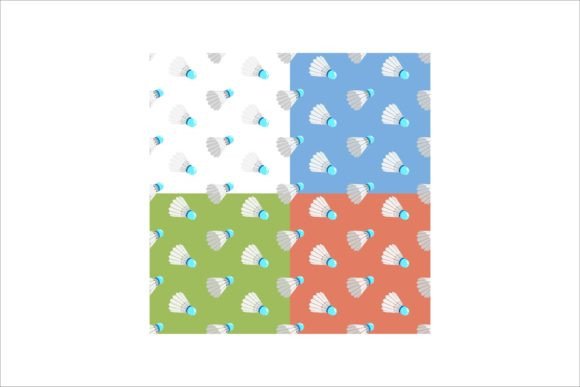
Set of Seamless Patterns with Shuttlecock
A Set of Seamless Patterns with Shuttlecock refers to a curated collection of vector-based, tileable graphic designs that incorporate the shuttlecock—a defining symbol of badminton—as a repeating motif. These patterns are constructed to repeat infinitely without visible seams, making them suitable for applications ranging from sportswear fabric printing to digital backgrounds, packaging, and decorative surfaces. Unlike standalone illustrations or logos, seamless patterns emphasize rhythm, scale, and visual continuity—ideal for translating the energy and precision of badminton into functional design assets.
Why Consider This Type of Pattern Set?
Designers, textile producers, and sports brand developers often seek visual elements that communicate sport identity while maintaining versatility across materials and formats. A Set of Seamless Patterns with Shuttlecock meets this need by embedding thematic relevance directly into the pattern structure—not as an afterthought, but as an integrated compositional element. Users may be evaluating such a set for reasons including:
- Developing branded apparel or accessories for badminton clubs, tournaments, or training programs;
- Creating custom-printed fabrics for gym bags, towels, or court-side banners;
- Designing digital interfaces, presentation templates, or social media assets aligned with sport themes;
- Adding subtle yet recognizable ornamentation to packaging for rackets, grips, or shuttlecock tins;
- Supporting educational or promotional materials where visual consistency reinforces topic focus.
Practical Benefits and Realistic Tradeoffs
Vector-based seamless patterns offer several tangible advantages. Because they are built in scalable vector format (typically SVG or AI), they retain clarity at any size—from thumbnail icons to full-wall murals. Their tileable nature simplifies production workflows: designers can apply them across large fabric rolls or digital canvases without manual repetition or alignment adjustments. Additionally, shuttlecock motifs—when stylized thoughtfully—can evoke motion, balance, and aerodynamic form, reinforcing key attributes associated with the sport.
However, there are tradeoffs to consider. Not all shuttlecock depictions translate well into seamless repetition. Overly detailed or asymmetrical shuttlecock renderings may disrupt tiling logic, resulting in visual clutter or unintended focal points. Some sets prioritize aesthetic cohesion over technical flexibility—e.g., using raster textures or fixed color palettes that limit customization. Also, while vector files support editing, modifying individual shuttlecock elements within a complex pattern may require intermediate proficiency in illustration software.
Key Considerations Before Selecting a Set
When evaluating a Set of Seamless Patterns with Shuttlecock, examine the following aspects objectively:
- Tile behavior: Preview how the pattern repeats. Does the shuttlecock placement create rhythmic flow—or does it produce unintended clustering or gaps?
- Color handling: Are colors defined in editable swatches (e.g., CMYK or Pantone-ready) or embedded as fixed RGB values? This affects print accuracy and brand alignment.
- File structure: Are individual pattern tiles delivered separately, or only as grouped artboards? Separate files simplify integration into textile design software like Adobe Illustrator’s Pattern Maker or specialized CAD systems.
- Scale range: Does the set include variants optimized for different uses—e.g., small-scale repeats for woven labels versus bold, large-scale motifs for banners?
- Licensing scope: Confirm whether usage rights cover commercial production, mass printing, or derivative design work—especially important for manufacturers and resellers.
Where This Pattern Set Fits Best
A Set of Seamless Patterns with Shuttlecock is especially well-suited when the goal is consistent, repeatable visual language rooted in sport-specific iconography. It works effectively in contexts where thematic resonance matters more than literal representation—such as background textures on sportswear linings, subtle border elements on tournament signage, or coordinated stationery for coaching academies. Its strength lies in supporting brand cohesion without dominating attention: the shuttlecock becomes part of the environment rather than the sole subject.
It also aligns well with production pipelines that rely on automated tiling tools or digital textile printers. Designers working with limited time or resources benefit from pre-tested, technically sound patterns that reduce trial-and-error in layout stages.
When Alternatives May Be More Appropriate
This type of pattern set may not be optimal in every scenario. For instance:
- If the project requires photorealistic or highly narrative imagery—like action shots of players mid-rally—a seamless pattern will lack contextual detail and emotional immediacy.
- When branding guidelines mandate strict use of a proprietary logo or mascot, introducing shuttlecock-based ornamentation could dilute visual hierarchy or violate identity standards.
- In applications demanding high contrast or tactile distinction—such as braille-inclusive signage or safety gear—the subtlety of a repeating shuttlecock motif may compromise legibility or function.
- If the target audience includes casual observers unfamiliar with badminton, the shuttlecock alone may fail to communicate sport identity clearly without supplementary text or iconography.
Making an Informed Decision
To determine whether a Set of Seamless Patterns with Shuttlecock serves your needs, begin by clarifying the primary function of the design. Ask: Is the goal to reinforce theme, enable production efficiency, support scalability, or meet specific technical constraints? Next, test the pattern in context—apply a sample tile to a mockup of your intended output (e.g., a fabric swatch, webpage background, or product label). Observe how it performs at actual size and under expected lighting or viewing conditions.
Compare against alternatives—not just other shuttlecock-themed assets, but also abstract geometric patterns, monogram-based repeats, or sport-adjacent motifs (e.g., racket silhouettes, feather textures, or court line abstractions). Evaluate each option against your criteria: adaptability, licensing clarity, file utility, and alignment with end-user expectations.
Finally, recognize that pattern choice is rarely about “best” in absolute terms—but about fit. A shuttlecock-based seamless set excels where continuity, symbolism, and technical reliability intersect. When those conditions match your project’s requirements, it offers a focused, reusable solution grounded in both sport context and design practicality.