Set of Seamless Patterns with Striped Be
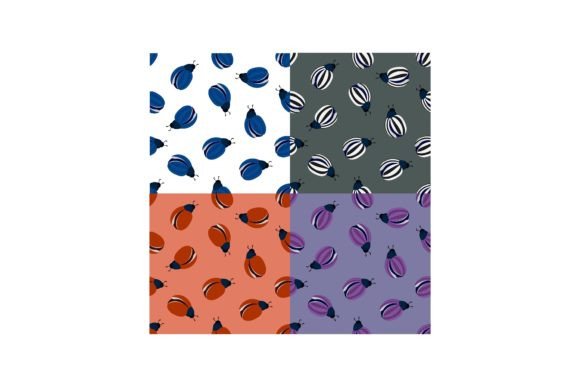
At first glance, “Set of Seamless Patterns with Stripped Be” might sound like a niche design term—until you see how it quietly bridges ecology, aesthetics, and modern production. This vector-based pattern collection features stylized striped beetles—some representing beneficial insects like lady beetles or ground beetles, others subtly echoing pest species such as striped cucumber beetles—rendered in repeatable, tileable layouts. The “Be” in the name is both a nod to beetle and a quiet play on be, suggesting presence, intention, and life. These aren’t just decorative motifs: they’re thoughtful visual translations of real-world entomological relationships, designed for creators who value meaning alongside usability.
Why Seamless Insect Patterns Are Gaining Ground
Designers and brands are moving away from generic florals or geometrics toward motifs with narrative weight—and insects, especially beetles, fit that shift perfectly. They’re among the most diverse animal groups on Earth, ecologically vital, and visually distinctive. A striped beetle pattern isn’t merely ornamental; it carries associations with resilience, adaptation, and balance—qualities increasingly resonant in sustainable branding, eco-conscious apparel, and educational materials. Unlike trend-driven graphics that fade after a season, insect-inspired seamless patterns tap into enduring cultural and scientific interest: think museum merch, nature-focused children’s textiles, or packaging for organic garden products.
This rise aligns with broader shifts in creative workflows. With print-on-demand platforms, digital embroidery software, and AI-assisted color variation tools becoming standard, professionals need high-fidelity, scalable assets that work across contexts—from a 200 dpi fabric swatch to a 3000×3000 px website banner. Vector-based seamless patterns meet that need precisely. They scale infinitely without quality loss, support precise color separation for screen printing, and integrate smoothly into Figma, Adobe Illustrator, or Canva workflows. No raster artifacts. No licensing ambiguity. Just clean, editable, production-ready files.
From Pest to Pattern: The Dual Role of Striped Beetles
The striped beetle motif is uniquely versatile because it reflects a real-world duality: some striped beetles protect crops (like the Pterostichus melanarius, a ground beetle that preys on slugs and cutworms), while others damage them (like the Acalymma vittatum, which vectors bacterial wilt in cucurbits). Designers using this set don’t ignore that complexity—they leverage it. A textile line for an urban gardening co-op might use a subtle, muted repeat featuring beneficial species alongside pollinator-friendly flora. Meanwhile, an agricultural extension service could adapt the same vector files into bold, high-contrast posters illustrating pest identification—changing only color, stroke weight, and annotation layers.
This duality also supports inclusive storytelling. Rather than presenting insects as universally “good” or “bad,” these patterns invite viewers to pause and consider context: habitat, behavior, human impact. That nuance matters—not just for educators or conservation communicators, but for marketers building authentic brand narratives. Consumers aged 20–50 increasingly favor transparency and ecological literacy. A scarf printed with a Set of Seamless Patterns with Striped Be doesn’t just look distinctive; it opens space for conversation about soil health, integrated pest management, or native biodiversity.
Practical Use Across Industries
Here’s where theory meets execution:
- Fabric & Apparel Designers: Use the vector files to create limited-run organic cotton scarves, linen napkins, or performance-wear for entomology field courses. Because the patterns are truly seamless, repeats align flawlessly across garment panels—even on bias-cut sleeves or curved hems.
- Educational Publishers: Extract individual beetle silhouettes to build illustrated glossaries, flashcards, or interactive PDFs. The vector format allows easy resizing, recoloring, and layering with labels or anatomical callouts—no pixelation when zooming in during classroom presentations.
- Small-Batch Product Brands: Apply the patterns to reusable produce bags, ceramic mugs, or seed packet wraps. The striped motif reads clearly at small scales (e.g., a 4 cm × 4 cm corner detail) and holds up under UV printing or heat transfer processes.
- Digital Creators & Bloggers: Embed pattern swatches as background elements in newsletters or social media banners. Pair them with short-form content—e.g., “Three beetles you’ll spot in your backyard this month”—to boost engagement without relying on stock imagery.
What Makes These Patterns Stand Out Technically
Not all seamless insect patterns deliver equal utility. What sets this set apart is its intentional construction:
- True vector geometry: Every stripe, contour, and negative space is built with Bézier curves—not traced raster art—ensuring crisp edges at any size and effortless global adjustments (e.g., shifting all stripes 10% lighter with one color swatch edit).
- Modular tile logic: Each pattern uses mathematical tiling (not simple offset copies), so edge transitions remain invisible even when scaled across large-format wallpaper or trade show backdrops.
- Ecologically informed stylization: Stripes follow real segmental anatomy—thorax vs. elytra—so the designs feel grounded, not cartoonish. That authenticity builds trust, whether used by a university extension office or a luxury textile house.
- Cross-platform compatibility: Delivered as .AI, .EPS, and SVG files, with layered organization (beetle group, background, repeat guides) so users can toggle visibility, isolate elements, or export subsets without rebuilding from scratch.
Evolving Expectations—and How This Set Responds
Five years ago, “eco-design” often meant swapping out a plastic icon for a leaf. Today, audiences expect deeper alignment: between visual language and scientific accuracy, between aesthetic choices and environmental values, between creative tools and ethical production practices. That’s why designers no longer settle for generic bug motifs—they seek assets with verifiable roots. This Set of Seamless Patterns with Striped Be was developed in consultation with entomologists and textile engineers, balancing biological fidelity with decorative function.
It also responds to workflow realities. Freelancers juggling three clients don’t have time to manually adjust tile boundaries or convert PNGs to vectors. Educators updating curriculum materials need assets that comply with accessibility standards (e.g., sufficient contrast ratios for beetle stripes against background tones)—something built-in, not retrofitted. And sustainability-focused brands require documentation: CMYK-safe palettes, PMS references, and clear usage rights. This set includes all of that—not as an afterthought, but as foundational design criteria.
Realistic Recommendations for Getting Started
If you’re considering integrating these patterns into your work, start small—but start intentionally:
- Test one pattern at multiple scales: Print a 5 cm × 5 cm swatch and a 50 cm × 50 cm sample on your target fabric. Observe how stripe density and negative space behave—some beetles read better at larger sizes, others shine in tight repeats.
- Pair with complementary typography: Choose typefaces with subtle organic warmth (e.g., a rounded sans-serif with open counters) rather than rigid tech fonts. The goal is harmony, not contrast-for-contrast’s-sake.
- Document your intent: If using the pattern commercially, note whether your application highlights beneficial roles (e.g., “This design features Chlaenius tricolor, a ground beetle that suppresses crop pests”) or serves identification purposes. That clarity strengthens credibility and avoids misrepresentation.
- Iterate with purpose: Don’t just recolor—adjust stripe rhythm. Try widening thoracic bands to emphasize movement, or thinning elytral stripes to suggest iridescence. The vector structure makes those experiments fast and reversible.
Ultimately, Set of Seamless Patterns with Striped Be succeeds because it treats design as translation—not decoration. It converts entomological insight into visual language, ecological awareness into tangible product, and professional need into reliable, adaptable tools. Whether you’re launching a regenerative fashion line, designing a school garden curriculum, or refreshing your brand’s visual identity, these patterns offer more than surface appeal. They offer a starting point—one grounded in observation, built for longevity, and ready to evolve with your work.