Tie Dye Seamless Patterns Vol- 08: A Practical Evaluation for Designers and Creators
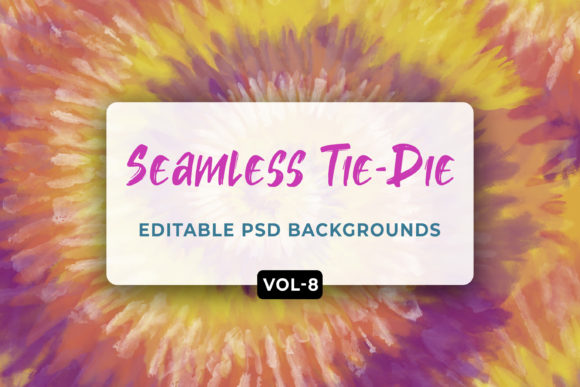
Tie Dye Seamless Patterns Vol- 08 is a curated digital asset pack containing five original, repeatable tie-dye designs—each crafted to tile seamlessly across surfaces without visible edges or breaks. Unlike generic stock patterns or algorithmically generated swirls, these designs reflect intentional color blending, organic flow, and balanced saturation levels suited for both physical production and digital display. The collection stands out not for novelty alone, but for its functional versatility and production-ready file structure.
What Makes This Set Distinctive in Practice
At its core, Tie Dye Seamless Patterns Vol- 08 delivers what many similar pattern packs don’t prioritize: editable fidelity without compromise. Each design comes as a fully layered PSD file—meaning every dye bleed, gradient overlay, and texture layer remains isolated and adjustable. You’re not locked into preset hues or fixed opacity levels. If a soft lavender-and-sage palette doesn’t suit your brand, you can shift base tones non-destructively using adjustment layers or hue/saturation masks.
The inclusion of high-resolution PNG files (with transparent backgrounds) adds flexibility for web use—especially where overlays, CSS background repeats, or SVG integration are needed. JPEG versions serve well for print previews or quick mockup insertion, while the 10 ready-to-use Zoom video backgrounds address a specific, growing need: professional yet expressive virtual presence. These aren’t cropped screenshots—they’re purpose-built compositions scaled and framed for standard webcam aspect ratios (16:9 and 4:3), with subtle depth and enough visual interest to hold attention without distraction.
How It Compares Across Common Use Cases
When evaluating Tie Dye Seamless Patterns Vol- 08 against other pattern resources—whether free repositories, subscription-based libraries, or custom commissions—the distinction lies in balance: it avoids oversimplification without requiring advanced technical skill.
- For apparel designers: Seamless tiling means no manual alignment when applying to fabric rolls or cut-and-sew templates. Compared to single-image tie-dye textures (which require cloning or distortion to fill large areas), these patterns scale predictably—reducing risk of misaligned seams on tote bags or oversized hoodies.
- For digital presenters and remote professionals: The Zoom backgrounds offer more cohesion than static photos or low-res GIFs. They’re also lighter in file size than animated alternatives, avoiding lag during screen sharing—unlike some motion-based virtual backdrops that demand higher bandwidth or GPU support.
- For print production: At 300 DPI and scalable vector-friendly dimensions (via PNG transparency), these work reliably for business cards, presentation decks, or textile swatch books. That’s a step above many free “tie dye” downloads, which often max out at 72 DPI or lack true seamlessness—leading to visible joins when tiled across posters or wallpaper.
Strengths—and Where Tradeoffs Emerge
The primary strength of Tie Dye Seamless Patterns Vol- 08 is consistency across formats. You get one cohesive aesthetic interpreted across five distinct variations—some with tighter concentric rings, others with softer watercolor diffusion or diagonal flow. That internal variety supports mood-matching: a vibrant coral-and-teal variant suits energetic branding, while a muted indigo-and-cream version reads more refined for editorial or hospitality contexts.
However, there are practical boundaries. Mockups aren’t included—so if you need photorealistic renders of these patterns on phone cases, laptop sleeves, or cushion covers, you’ll need to source or build those separately. Similarly, while the PSD files are editable, they assume basic familiarity with Photoshop layers and blending modes. Someone relying exclusively on Canva or Figma may find the PSD format less immediately accessible—though the PNG and JPEG files still provide usable fallbacks.
Another consideration is stylistic scope. These are hand-crafted tie-dye interpretations—not generative AI outputs or ultra-minimalist abstractions. If your project calls for geometric precision, monochrome reduction, or hyperrealistic fabric simulation (e.g., visible thread count or weave texture), this set won’t fulfill those needs. It prioritizes fluidity and rhythm over structural control or photorealism.
When Tie Dye Seamless Patterns Vol- 08 Fits—and When It Doesn’t
This set works best when your goal is expressive, repeatable color energy with minimal setup time. Consider it if you’re:
- Developing a seasonal product line for apparel or home goods and need consistent background treatments across multiple SKUs;
- Designing a branded Zoom environment for a team, workshop, or client-facing webinar—and want something distinctive but not overwhelming;
- Creating digital stationery, social media templates, or presentation decks where background texture supports hierarchy without competing with content;
- Prototyping textile concepts before committing to physical dye trials or digital printing runs.
Conversely, Tie Dye Seamless Patterns Vol- 08 may fall short if you require:
- Format diversity beyond raster files: There are no SVG, EPS, or AI vector exports—so scaling to billboard size without pixelation isn’t feasible without upscaling tools or redesign.
- Thematic expansion: It’s a focused volume—not a library. You won’t find ombre gradients, batik motifs, or shibori-inspired geometry here. It’s tie-dye, interpreted five ways—not a broader textile pattern toolkit.
- Commercial license clarity beyond standard terms: While typical extended licenses cover most product applications (apparel, merchandise, digital use), projects involving resale of the pattern files themselves—or embedding in SaaS platforms—require verification of the specific license terms provided with purchase.
Real-World Application Examples
A small-batch ceramic studio used one of the designs as a repeating background on their Shopify product pages—subtly reinforcing their handmade, artisan identity without covering product photography. They adjusted the PNG’s opacity to 12% via CSS, letting the texture recede behind clean typography.
A freelance educator created a set of workshop slide decks using two variants—one for title slides (bolder contrast), another for section dividers (lower saturation). Because both shared the same underlying color logic, transitions felt intentional rather than arbitrary.
A boutique bag label applied the seamless pattern directly to a fabric printer’s RIP software, producing yardage for reversible totes. The absence of visible tile edges meant no extra trimming or seam allowances were needed during cutting—saving material and labor time.
Making an Informed Choice
Tie Dye Seamless Patterns Vol- 08 occupies a pragmatic middle ground: more refined than free pattern sites, less complex than commissioning custom artwork, and more adaptable than static image packs. Its value isn’t in exclusivity alone—it’s in reducing friction between concept and execution.
If you’re weighing options, ask yourself: Do I need immediate usability across web, print, and physical products? Is color adaptability essential—not just for branding, but for seasonal updates or audience-specific variations? Do I benefit from having both editable source files and ready-to-drop raster assets?
When those needs align, Tie Dye Seamless Patterns Vol- 08 offers tangible efficiency. When your work demands specialized formats, extreme scalability, or stylistic range beyond organic dye aesthetics, it’s worth exploring complementary resources—even if that means combining this set with targeted alternatives.