Unicorn Seamless Patterns: Creative Freedom, Without the Gaps
If you've ever tried tiling a background image only to spot that awkward seam where the edges don’t quite match—where colors shift or elements misalign—you know how frustrating it can be. Unicorn Seamless Patterns solve that problem elegantly. These aren’t just cute unicorn-themed graphics—they’re precision-crafted digital papers designed to repeat infinitely, edge-to-edge, without visual breaks. Each pattern flows smoothly into itself, so whether you're filling a full-page journal spread or wrapping an entire t-shirt design, the magic stays consistent.
Where These Patterns Actually Shine (Beyond “Just Cute”)
What makes Unicorn Seamless Patterns more than decorative flair is how they slot into real creative workflows—quietly, reliably, and often unexpectedly.
- Scrapbookers love them for layered page backgrounds. Instead of wrestling with cropping or resizing a single image to cover a 12×12 inch layout, you drop in one seamless tile and let it repeat. It saves time—and keeps your focus on storytelling, not pixel alignment.
- Journal enthusiasts use them as printable inserts. A soft pastel unicorn pattern behind handwritten reflections or gratitude lists adds gentle personality without overwhelming the text. Because it’s seamless, you can scale it to fit any journal size—A5, dotted bullet, or custom-bound—without distortion.
- Small-batch apparel designers apply them directly to fabric mockups or print-on-demand platforms. One 4800×4800 px JPEG at 300 DPI gives enough resolution for a toddler romper, a tote bag, or even a duvet cover—all from the same file. No need to rework repeats or hire a pattern specialist.
- Web designers building landing pages or Shopify themes sometimes reach for these as subtle, brand-aligned textures. A low-opacity overlay of a whimsical unicorn motif can soften a stark white background while reinforcing a playful, inclusive, or child-focused identity—without slowing load times (since it’s a single optimized JPEG).
- Paper product creators—think greeting cards, gift tags, or sticker sheets—use these patterns as base layers before adding die-cut shapes or foil accents. The seamless nature means no worrying about visible borders when trimming or scoring.
Who Finds This Especially Useful—and Why
It’s not just about who uses Unicorn Seamless Patterns, but *how* their needs align with what the kit delivers.
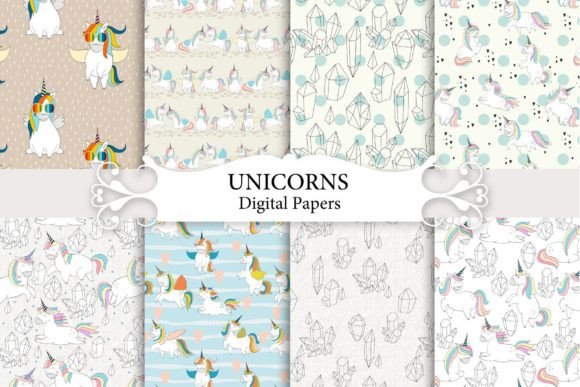
A freelance illustrator launching a children’s stationery line might need cohesive, scalable backgrounds fast—no waiting for custom repeats or licensing restrictions. With eight unique designs included, she can test different moods: dreamy watercolor unicorns for baby shower invites, bold geometric ones for back-to-school stickers, or glitter-textured versions for birthday party printables.
Meanwhile, a mom running a small Etsy shop making handmade baby clothes may not have hours to learn vector tiling in Illustrator. She downloads the kit, opens one JPEG in Canva or Photoshop, adjusts opacity or hue to match her fabric swatches, and applies it directly to a mockup. Done in minutes—not days.
Even educators designing classroom resources lean into these. A teacher creating printable behavior charts or reward certificates can add a light unicorn pattern as visual scaffolding—making materials feel inviting without distracting from learning goals. Because the files are high-res and seamless, they hold up beautifully when printed on standard office printers or laminated for reuse.
What to Keep in Mind Before You Start Tiling
While Unicorn Seamless Patterns are built for flexibility, a few practical notes help avoid hiccups:
- Color mode matters. These are delivered as RGB JPEGs—ideal for screen use and most print-on-demand services. If you’re sending files to a traditional offset printer, confirm whether they require CMYK conversion first (some do; many modern POD platforms don’t).
- Tile behavior is predictable—but previewing helps. Even seamless patterns can look subtly different depending on scale or contrast settings. Try applying one at 50% size and 200% size in your editor to see how motifs interact. Some designs read better large; others shine when zoomed in.
- “Seamless” doesn’t mean “invisible.” These are artistic interpretations—not clinical algorithms. A few include delicate halos, soft glows, or intentional texture variation that enhances charm but may affect ultra-minimalist projects. That’s a strength for expressive work, less so for strict corporate branding.
- Licensing is straightforward—but check scope. The kit allows commercial use (yes, for baby clothes, digital planners, physical prints), but always verify if your end product involves redistribution of the pattern file itself (e.g., selling editable templates that include the raw JPEG). Most personal and small-business uses are covered—just double-check if your model is unusual.
Why Eight Designs—and Why 4800×4800 Pixels?
The number isn’t arbitrary. Eight gives variety without overwhelm—enough to explore moods (whimsical, elegant, bold, ethereal) while keeping curation simple. And 4800×4800 pixels at 300 DPI? That’s the sweet spot between quality and usability. It’s large enough to scale across a wide-format poster or yard of fabric without interpolation blur, yet manageable for laptops and tablets. You won’t hit memory limits in Canva or crash older versions of Photoshop trying to open them.
You’ll notice too that each pattern balances detail and breathability. Too much density feels busy in print; too little loses impact on apparel. These strike a middle ground—visible enough to delight, quiet enough to support other elements.
Real Moments Where It Just Works
Think of the parent rushing to finish a last-minute birthday banner. She drops a unicorn pattern into her design tool, tiles it behind hand-lettered names, and hits print—no second-guessing alignment. Or the indie card maker testing three new greeting card concepts in one afternoon, swapping patterns like filters to see which resonates most with her audience. Or the digital planner designer embedding a subtle shimmer pattern behind habit trackers—so users feel uplifted every time they open their app.
That’s the quiet power of Unicorn Seamless Patterns: they remove friction so creativity stays front and center. Not as the star of the show—but as the steady, supportive rhythm underneath everything else.