Watercolor Seamless Patterns with Pigs
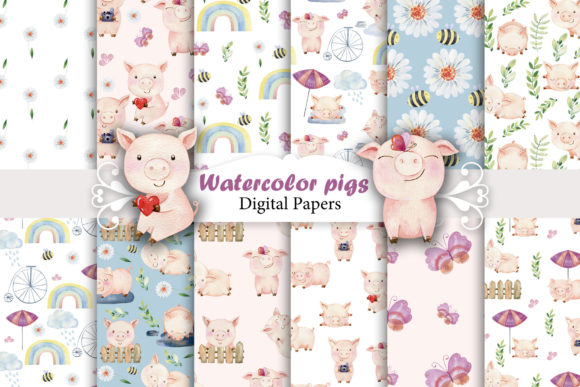
Imagine soft, hand-painted pig motifs—playful, gentle, and full of quiet charm—blending seamlessly across any surface you design. Watercolor Seamless Patterns with Pigs is a curated digital kit built for makers who value both authenticity and flexibility. It’s not just decorative; it’s functional art designed to scale, repeat, and adapt without visible seams or loss of quality. Each pattern carries the warmth of real watercolor texture—the subtle blooms, delicate granulation, and organic edges that digital brushes often miss.
This kit includes 12 high-resolution JPEG files, each sized at 16 by 16 inches and rendered at 300 DPI. That resolution ensures crisp output whether you’re printing a large-format wall mural or embroidering a tiny onesie. And because every image is truly seamless, you can tile it infinitely—left to right, top to bottom—without breaks or misaligned edges. No extra editing, no patching, no guesswork. Just open, place, and scale.
Why Seamless Watercolor Pig Patterns Stand Out
In a landscape crowded with vector repeats and flat clipart, watercolor-based seamless patterns offer something distinct: tactile realism with practical repeatability. The pig motifs here aren’t cartoonish or overly stylized—they’re gentle, rounded, and expressive, drawn with intentional looseness. That makes them versatile across age groups and contexts: equally fitting for a baby shower invitation as for a boutique stationery line or an educator’s classroom bulletin board.
What sets this collection apart isn’t just the subject—it’s how the watercolor medium supports intentionality. Unlike rigid geometric repeats, these patterns invite breathing room. They soften digital interfaces, add warmth to printed packaging, and lend handmade credibility to mass-produced items—all while remaining technically precise for production use.
Creative Uses Across Real Projects
Designers and crafters have already applied these patterns in ways both expected and inventive:
- Scrapbooking & Journaling: Use as full-page backgrounds for memory keeping, or crop sections for custom dividers, headers, or sticker sheets. The watercolor texture adds depth without overwhelming handwritten notes or photos.
- Apparel & Baby Clothing: Scale down for fabric prints on rompers, bibs, or swaddle blankets. The soft pig silhouettes read clearly even at small sizes, and the seamless nature means no awkward repeats at seam lines.
- Digital & Web Design: Apply as subtle CSS background textures for blogs, landing pages, or email headers. Because they’re 300 DPI and tile cleanly, they hold up beautifully on retina displays—and can be exported at lower resolutions for faster loading without sacrificing visual integrity.
- Paper Goods & Packaging: Ideal for letterpress-inspired business cards, gift tags, or wrapping paper. Pair with minimalist typography to let the texture speak, or layer with spot varnish in print for tactile contrast.
- Art & Mixed Media: Print on watercolor paper and rework with actual paint, ink, or collage elements. The base pattern becomes a starting point—not a final layer.
Adapting for Different Audiences and Goals
A freelance graphic designer pitching to a children’s bookstore might use one pig pattern as a textured backdrop behind clean sans-serif type—emphasizing approachability and calm. An Etsy seller launching a line of organic cotton baby blankets could tile the same pattern across a full yard of fabric, then pair it with coordinating solid colors for binding and labels.
For educators, these patterns work well in printable resources: behavior charts with pig-themed rewards, themed reading logs, or calming classroom visuals. The watercolor softness reduces visual fatigue—especially helpful for younger learners or neurodiverse students.
Bloggers and content creators use them to unify visual branding: consistent background textures across Pinterest pins, Instagram story templates, and downloadable checklists. Because all 12 patterns share the same color palette and textural language, switching between them maintains cohesion—even when used across different posts or campaigns.
Practical Tips for Best Results
To keep your projects clear and audience-friendly, consider these straightforward recommendations:
- Test tiling first. Even with seamless files, zoom in at 200% in your design software to verify edge alignment—especially if you’re using older versions of Photoshop or Affinity Designer.
- Adjust saturation thoughtfully. Watercolor textures respond well to slight desaturation for vintage looks or gentle brightness boosts for modern clarity—but avoid over-editing, which flattens the natural pigment variation.
- Pair with purposeful typography. Serif fonts like Playfair Display or Lora complement the organic flow; clean sans-serifs like Inter or Poppins create intentional contrast. Avoid overly decorative fonts that compete with the pattern’s detail.
- Respect scale context. A 16×16 inch file gives flexibility—but for apparel, test print a 6×6 inch swatch first. For web use, export at 1920×1080 or smaller unless using as a hero section background.
- Maintain consistency in tone. If you choose a muted lavender-and-cream pig motif for your brand, stick with complementary patterns from the kit—not high-contrast reds—unless intentionally shifting moods (e.g., holiday edition).
More Than Just a Pattern Kit
This isn’t only about filling space with pigs. It’s about choosing materials that reflect care—in execution, in audience consideration, in attention to physical and digital context. Whether you’re designing a birth announcement, prototyping a textile line, or building a teacher resource site, Watercolor Seamless Patterns with Pigs supports decisions that feel grounded, not generic.
It invites iteration without exhaustion: try rotating a single tile 90 degrees for a fresh layout; overlay two patterns at low opacity for dimension; or extract one pig silhouette as a standalone icon. The files are yours to reinterpret—not just repeat.
If you’re evaluating tools for your next creative project, ask: Does it save time *and* deepen expression? Does it scale across formats without compromise? Does it leave room for your voice—not just fill a background? That’s where this kit delivers: quietly capable, gently distinctive, and ready to support work that matters to real people.
Please send a message if you have any questions. Thank you.